THE FOOD WE EAT · A THREE-PART KITCHEN GUIDE
10 foods for gut health.
And how to actually cook with them.
Your next step might already be in your pantry. Before buying another supplement, let’s talk about beans, oats, vegetables—and making them taste good enough to eat regularly.
Chef Gringo editorial · Published October 25, 2026 · Evidence checked October 25, 2026
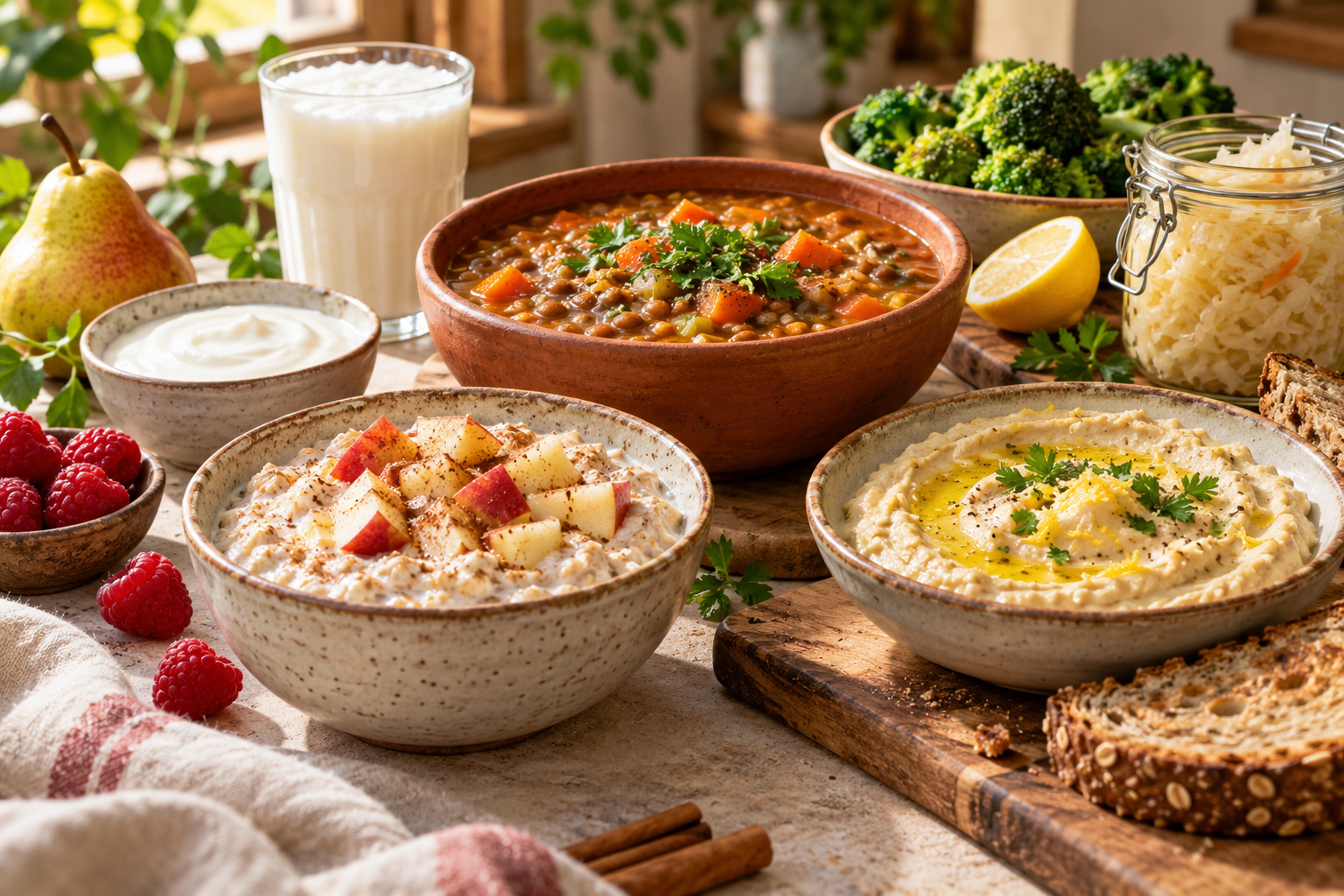
This is the practical companion to What Are We Feeding Our Kids?. The next question is what to put on the plate. This list is a useful shopping and cooking guide, not a scientifically ranked top ten or a treatment plan.
01 / THE EVERYDAY FOUNDATION
Start with the food you can repeat.
“Gut health” is an umbrella term, not one measurable score. Regular bowel habits, digestive comfort and the composition of gut microbes are different outcomes. A food can supply useful fiber without having been shown to change all three.
FDA fiber Daily Value for nutrition labeling. Your individual needs can differ.[1]
US adults with constipation symptoms in the estimate cited by NIDDK—not a measure of everyone with “poor gut health.”[4]
Adults age 60 and older with symptoms in the same NIDDK summary. Definitions and populations affect estimates.[4]
Fiber supports bowel regularity. NIDDK recommends adding it gradually and drinking enough fluids to help it work. An abrupt leap from very little fiber to a large bowl of beans can be uncomfortable; that is a reason to adjust the portion and pace, not a reason to declare all beans bad.[3]
Seven fiber-rich choices to keep in rotation
- Oats. A familiar whole-grain starting point. Soak rolled oats for breakfast, cook them as porridge, or add them to a savory bowl. Check the package for the fiber in your actual dry or cooked portion; those measurements are not interchangeable.
- Lentils. They cook without the long soaking step used for many dried beans. Brown and green varieties hold their shape; red lentils soften into a thicker soup. Roast some of the vegetables separately for more flavor.
- Beans and chickpeas. Canned versions make this realistic on a worknight. Drain and rinse, then fold into soup, mash into dip, or replace part of a taco filling. Use portions you tolerate.
- Berries. Fresh or frozen both have a place. Stir into oats or simmer into a quick compote. The table below uses raspberries; it does not assign the same fiber number to every berry.
- Apples and pears. Wash well and keep edible skins when practical. Dice into breakfast, roast with cinnamon, or slice alongside a savory lunch. Choose textures appropriate for the person eating.
- Broccoli and other vegetables. Browning, a little oil and a bright finish can turn a bland side into something worth repeating. Try cooked vegetables if a large raw salad feels like too much.
- Nuts. A small handful or chopped topping adds texture. Toast gently and cool before storing. Adapt for allergies and choking risks; whole nuts are not suitable for everyone.
Put serving sizes next to the numbers
These are reference food values, not calculated nutrition for our recipes. Brand, variety and preparation can change the amount. Listed portions are comparison units, not instructions to eat every food in that quantity.[2]
| Food | Portion | Fiber | Share of 28 g DV* |
|---|---|---|---|
| Lentils, cooked | ½ cup | 7.8 g | 28% |
| Black beans, cooked | ½ cup | 7.5 g | 27% |
| Chickpeas, cooked | ½ cup | 6.3 g | 23% |
| Raspberries | 1 cup | 8.0 g | 29% |
| Pear | 1 medium | 5.5 g | 20% |
| Apple, skin on | 1 medium | 4.8 g | 17% |
| Broccoli, cooked | 1 cup | 5.2 g | 19% |
| Almonds | 1 ounce | 3.5 g | 13% |
*Chef Gringo calculation: fiber grams ÷ 28 × 100, rounded. For example, ½ cup cooked lentils plus 1 cup raspberries provides about 15.8 g in this reference table—roughly 56% of the labeling Daily Value. This is arithmetic, not a recommendation to add both at once.
02 / READ PAST THE BUZZWORD
Fermented does not automatically mean probiotic.
Fermentation describes how a food is made. Live cultures describe microbes present when it is eaten. “Probiotic” requires defined microorganisms with evidence of benefit in adequate amounts. Heat treatment and processing can remove living organisms; a sour taste alone tells you very little.[7]
- Plain yogurt with live cultures. Use in breakfast or a lemon-herb sauce. Look at the label, choose a product you tolerate, and use yogurt made with pasteurized milk.
- Kefir with live cultures. A tangy drink or smoothie base. Compare added sugar and portion sizes rather than assuming every bottle is equivalent.
- Fermented vegetables. Sauerkraut or kimchi can be a condiment alongside a meal. Check sodium and processing information. Vinegar-pickled vegetables are not automatically fermented, and fermented products are not automatically clinically proven probiotics.

The Stanford study: promising, small, specific
Healthy adults in the analyzed study cohort.[5]
The dietary intervention: 4 weeks ramping up, then 6 weeks maintaining intake.[5]
Measured inflammatory proteins decreased in the fermented-food group, according to Stanford’s summary.[6]
The 2021 study compared high-fiber and high-fermented-food diets. Fermented-food intake rose from an average 0.4 to 6.3 servings a day, and microbial diversity increased. Those study servings are not a general daily prescription. In the fiber arm, average intake rose from 21.5 to 45.1 g/day, but overall microbial diversity did not increase over this short interval.[5]
The useful kitchen takeaway is modest: fermented foods can be part of a varied menu if you enjoy and tolerate them. They do not replace fiber-containing plants, prescribed treatment or individualized advice.
03 / PUT IT ON THE PLATE
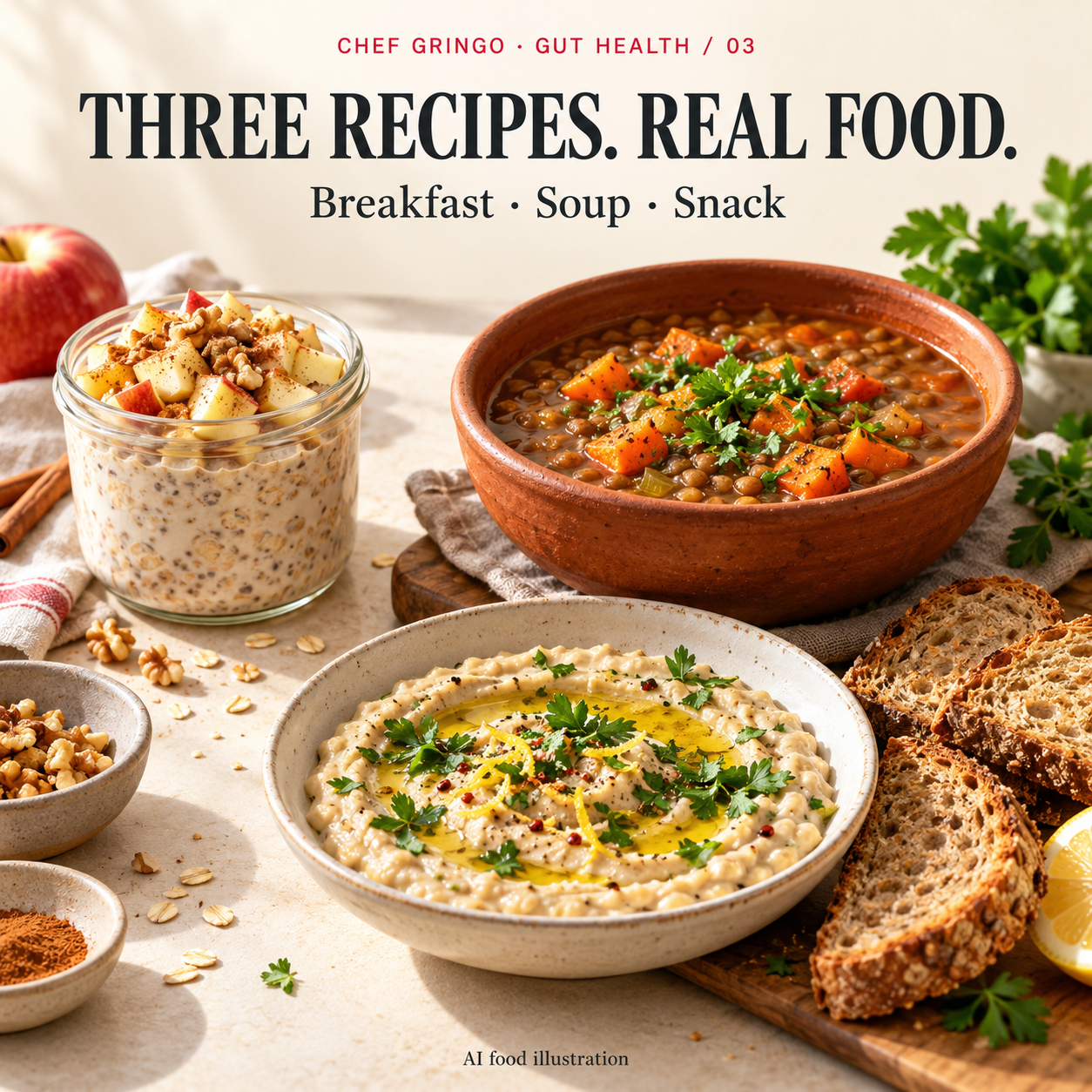
Three recipes. A breakfast, a pot of soup, a snack.
The goal is repeatable cooking. Each recipe is logged in the recipe library under Gut-health food series, with its own food type. Ingredients, steps, yield, allergens and storage instructions are included. These are complete written concepts, not kitchen-tested recipes; nutrition totals have not been calculated.
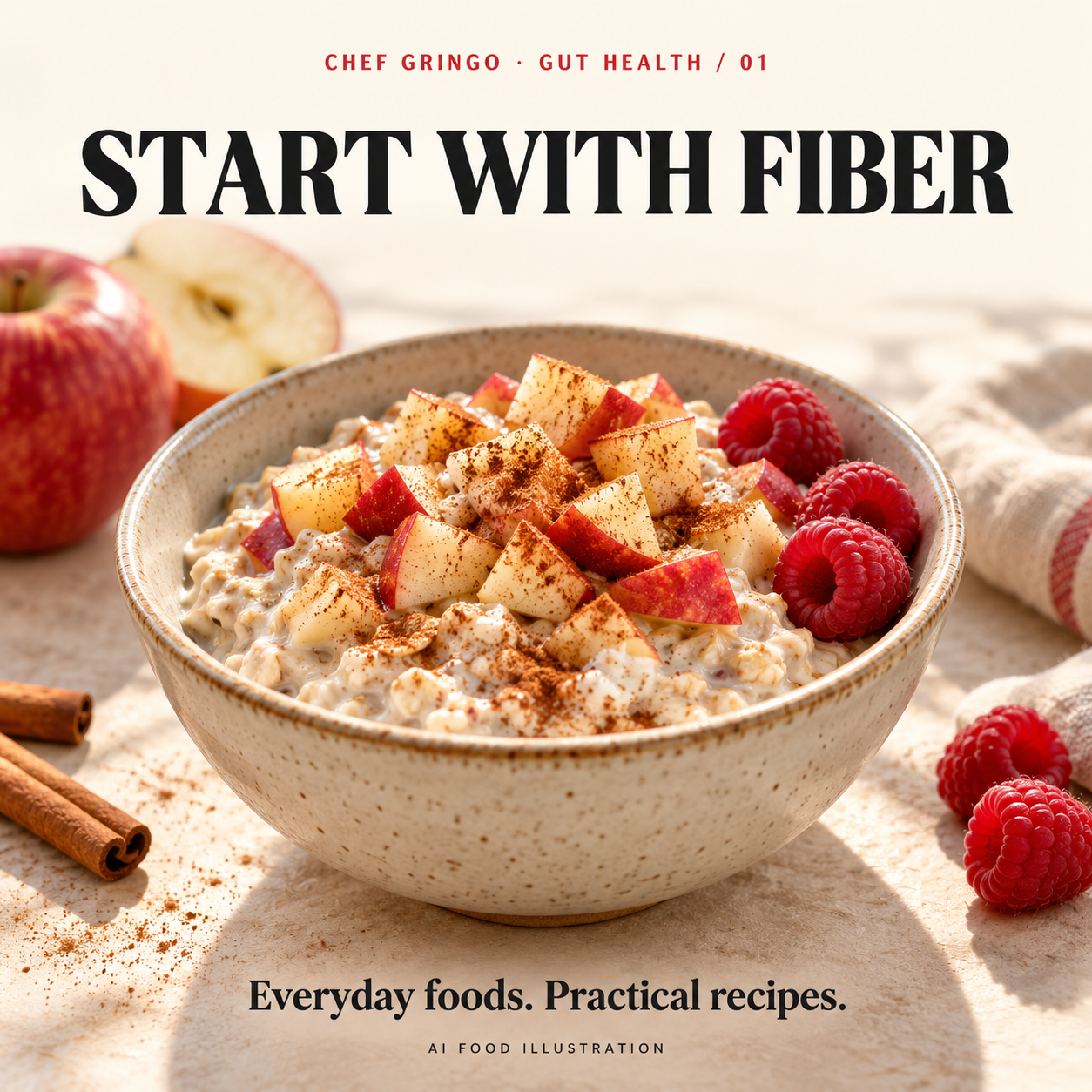
Breakfast
Apple-Cinnamon Overnight Oats
A make-ahead breakfast with rolled oats, plain yogurt, crisp apple and cinnamon. A small amount of lemon keeps the fruit tasting bright.
2 breakfast servings
10 minutes prep · at least 6 hours chilling · no cooking
Soups
Roasted Carrot & Lentil Soup
Brown or green lentils give this soup body; roasted carrots bring sweetness and browned edges. Lemon finishes the pot without needing a heavy cream base.
About 6 cups · 4 servings of approximately 1½ cups
15 minutes prep · 35–45 minutes cooking (overlapping) · about 60 minutes total
Appetizers & snacks
Lemon-Herb White Bean Dip
A smooth, tahini-free bean dip with lemon, olive oil and parsley. Serve with vegetables or whole-grain toast, or use as a sandwich spread.
About 1½ cups · 6 servings of approximately ¼ cup
10–15 minutes · no cooking when using canned beans
A practical shopping list
Pantry: rolled oats, dry brown or green lentils, canned white beans, olive oil, cumin, smoked paprika and cinnamon. Produce: apples, carrots, onion, celery, garlic, lemons and parsley. Refrigerated: pasteurized milk and plain yogurt. Optional berries, walnuts and whole-grain bread complete the serving ideas.
Use store-brand oats and beans if they suit your budget. Buy only the spices you will reuse. Frozen berries prevent the pressure to finish a fresh carton immediately. Prices vary, so this guide does not promise a made-up cost per serving.
Technique makes the habit easier
- Mix two breakfast portions at once rather than committing to a week of food you have not tried.
- Roast the carrots while the lentils simmer. Browning builds flavor without making the whole soup heavy.
- Loosen bean dip with water a tablespoon at a time; more oil is not the only way to get a creamy texture.
- Finish soup and dip with lemon after tasting. Acid gives a clearer sense of balance than adding salt automatically.
Food safety is part of gut health, too
Refrigerate perishables at 40°F or below within 2 hours, or within 1 hour above 90°F. Divide hot soup into shallow containers. Use refrigerated cooked leftovers within 3–4 days and reheat to 165°F. The oats recipe uses a conservative 3-day limit. Follow shorter product instructions when applicable.[8]
Make one change you can keep.
Choose a familiar meal and add one manageable change: oats for breakfast, some lentils in lunch, or bean dip with a snack. Notice comfort and tolerance before increasing portions. An adult food list is not a pediatric prescription; children need age-appropriate portions and safe textures.
If you have a digestive condition, a prescribed restricted diet or symptoms that persist, work with a clinician or registered dietitian on what fits you. More fiber is not automatically the right answer for every condition. This article offers food education, not diagnosis or treatment.
What would you try first: breakfast oats, lentil soup or white-bean dip? Start with the dish you will actually want again.
Browse the three recipes → · Medical & nutrition information
Sources, dates & limitations
Sources checked October 25, 2026. Publication dates and dataset dates are retained so older findings are not presented as new 2026 research. Numeric comparisons above use the cited reference portions. No supplement sponsorship or affiliate purchase is needed for this guide.
- FDA: How to understand the Nutrition Facts label
28 g fiber Daily Value; a label reference, not an individualized prescription. - USDA/HHS: Food Sources of Fiber, August 2024
Portion values from the published table; underlying FoodData Central data are from 2019. - NIDDK: Eating, Diet & Nutrition for Constipation
Gradual fiber increases, food sources and fluids. - NIDDK: Definition & Facts for Constipation
US symptom estimates: approximately 16 in 100 adults and 33 in 100 adults age 60 or older. - Wastyk et al., Cell, 2021: Gut-microbiota-targeted diets modulate human immune status
Primary study, intervention methods, dietary intake and limitations. - Stanford Medicine: Fermented-food study summary, July 12, 2021
36 healthy adults, 10-week intervention and 19 measured inflammatory proteins. - ISAPP: Fermented foods
Why fermented foods, live cultures and probiotics are not interchangeable terms. - USDA: Leftovers and Food Safety
Refrigeration, leftovers and reheating guidance used in the recipes.