Food Intelligence · Foundations of Flavor No. 1
Mirepoix: The 300-Year Story Hiding Under Your Dinner
Cut size, heat, history, and why the familiar 2:1:1 formula is only the beginning.
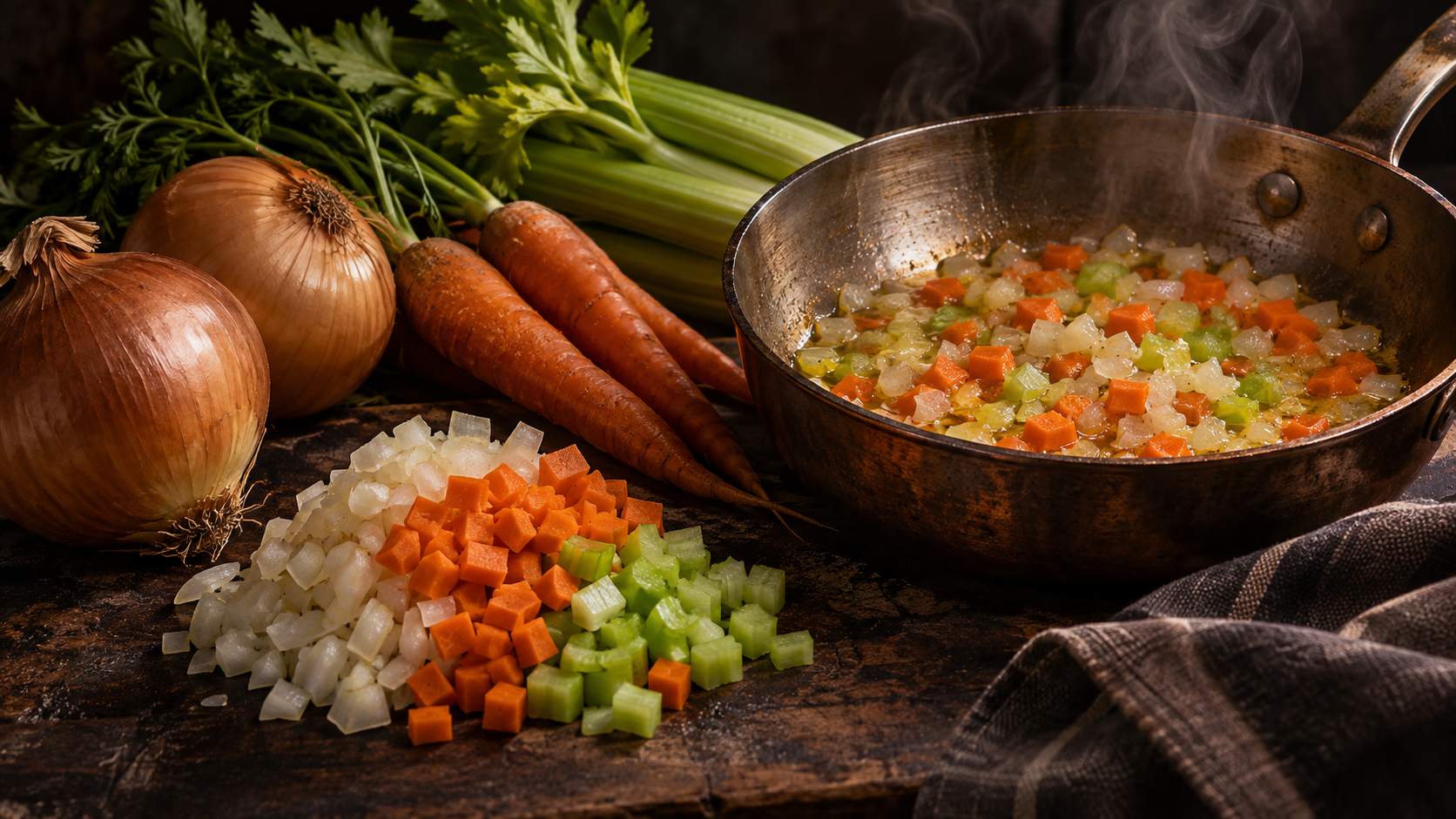
Every culinary student learns the same shorthand: onion, carrot, celery. Two parts onion, one part carrot, one part celery. Dice it, sweat it, move on.
That formula is useful. It is also the least interesting part of the story.
Mirepoix did not arrive in a kitchen as a laminated 2:1:1 chart. The name is tied to an eighteenth-century French aristocrat, early preparations carrying the name could be richer and more elaborate than today's vegetable mix, and professional cooks spent generations refining the broader idea behind it: build flavor before the main ingredient ever gets a chance to speak.
The famous claim that an unnamed chef working for the Duc de Mirepoix invented the preparation is traditional attribution, not a historical fact we can prove beyond dispute. We label that uncertainty instead of turning folklore into certainty.
The duke got the name. The chef may have done the cooking.
The culinary word mirepoix is traditionally associated with Charles-Pierre-Gaston François de Lévis, Duc de Mirepoix, a French aristocrat and diplomat in the courtly world of Louis XV. Etymological sources place the culinary term in the early nineteenth century and describe the story of the duke's chef as a supposed origin rather than a fully documented invention story. Etymonline: mirepoix etymology
That distinction matters. History is full of dishes attached to patrons, cities and famous households while the actual cooks disappear from the record. Mirepoix fits that pattern almost too neatly: the nobleman's name survives in kitchens around the world; the cook traditionally credited with the preparation is not securely identified.
The useful historical question is not “Who invented chopped vegetables?” It is how a name connected to an aristocratic household became shorthand for one of professional cooking's most common flavor foundations.
Before 2:1:1, mirepoix was a broader idea
French cooks were layering aromatic ingredients long before the modern culinary-school formula existed. Seventeenth- and eighteenth-century French cooking increasingly emphasized stocks, sauces, essences, aromatic herbs and the deliberate extraction of flavor. The Bibliothèque nationale de France's historical gastronomy collection traces that larger movement through cooks such as La Varenne, Massialot, Menon and later professional writers. Bibliothèque nationale de France: foundations of French gastronomy
By 1814, Antoine Beauvilliers' L'Art du Cuisinier included a preparation called Sauce à la Mirepoix. What matters is that this was not simply a bowl of raw onion, carrot and celery waiting beside the stove. Nineteenth-century preparations under the name could involve vegetables, butter or other fat, wine, herbs, stock and meat-based components—closer to a deliberately concentrated flavor preparation than today's stripped-down shorthand. Beauvilliers, L'Art du Cuisinier (1814), digitized by Gallica
As professional French cuisine became more systematized, the term narrowed. By the Escoffier era, mirepoix sat inside a highly organized culinary language of stocks, sauces, garnishes and aromatic preparations. Even then, historical versions could still include pork or ham, herbs and wine alongside vegetables—another reminder that the modern meatless mixture is an evolution, not a frozen eighteenth-century recipe. Auguste Escoffier, Le Guide Culinaire
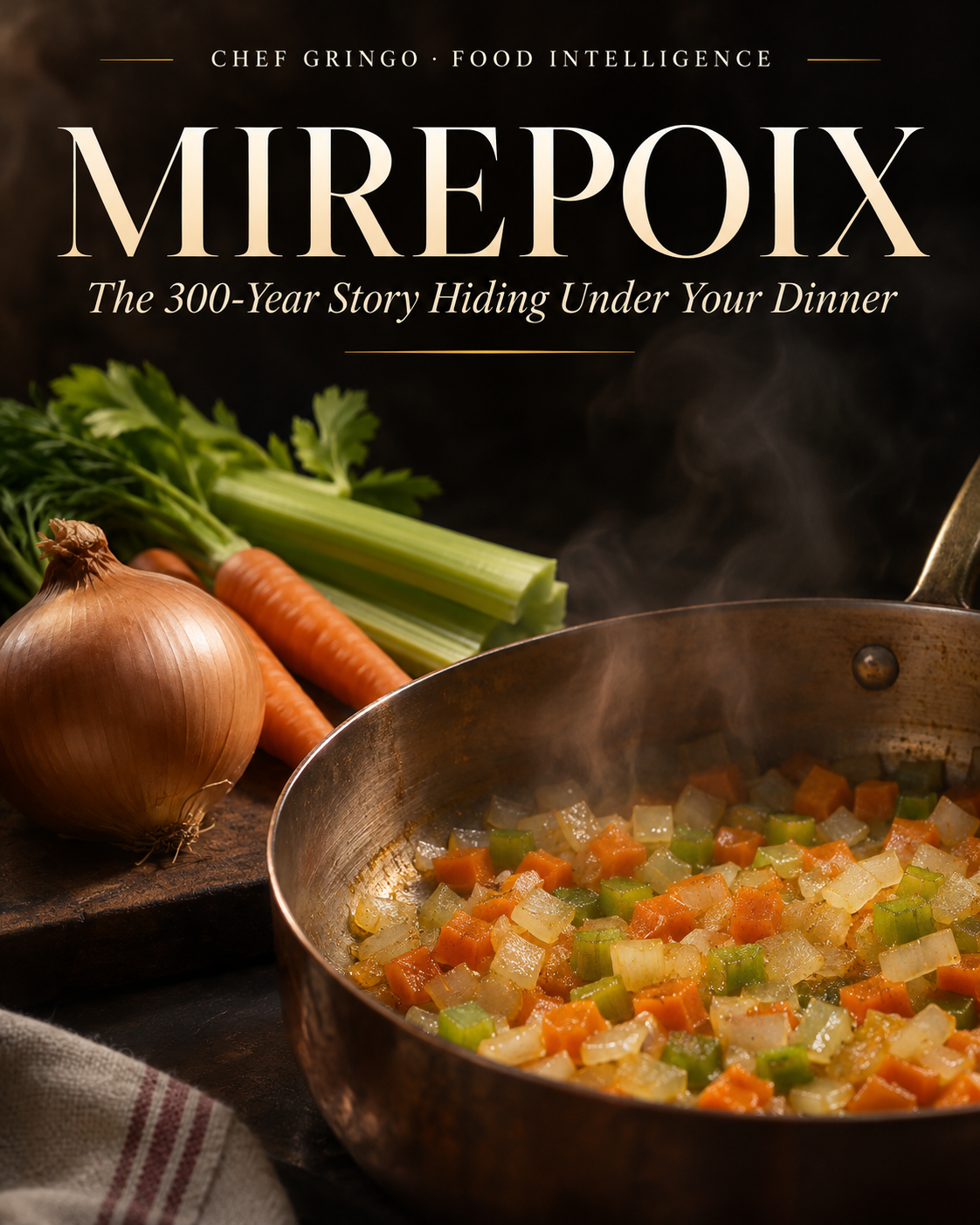
So where did 2:1:1 come from?
Today, many professional kitchens and culinary programs teach a practical ratio of 2 parts onion : 1 part carrot : 1 part celery by weight. The Culinary Institute of America presents that as the familiar working standard for classic mirepoix. Culinary Institute of America: mirepoix
Treat that ratio as a starting point, not scripture. The ratio creates a balanced aromatic base in which onion carries most of the volume, carrot contributes sweetness and earthy aroma, and celery adds a distinctive savory-herbal note without taking over. But the right composition still depends on what you are making.
- Delicate white soup or sauce: reduce color-producing ingredients or use white mirepoix.
- Long brown braise: a more assertive aromatic base and deeper browning may be welcome.
- Short soup or pan sauce: a smaller cut accelerates extraction.
- Six-hour stock: larger pieces are usually more practical and easier to strain.
Understand the function before you modify the formula.
Why onion, carrot and celery work together
Saying “onion adds flavor, carrot adds sweetness and celery adds aroma” is not wrong. It is just too shallow for a technique this important. Each vegetable brings a different family of flavor compounds, and heat changes what the cook experiences.
Onion: the sulfur engine
Cut an onion and you rupture cells that had been keeping enzymes and sulfur-containing precursors apart. Once those systems meet, a cascade of volatile sulfur compounds helps produce the sharp aroma associated with freshly cut onion. Onion flavor chemistry is heavily shaped by these organosulfur compounds. American Chemical Society: onion flavor chemistry
Gentle cooking changes that experience. Raw pungency softens, sweetness becomes easier to perceive, and onion moves from something that announces itself to something that supports everything around it.
Carrot: sweetness plus terpene-driven aroma
Carrots contribute sugars, but sweetness is only part of their job. Modern reviews describe a complex volatile profile in which terpenoids are important contributors to characteristic carrot aroma. Processing and heat alter that volatile profile, which is one reason raw, simmered and roasted carrot do not smell or taste identical. Open-access review of carrot aroma chemistry
Celery: the quiet amplifier
Celery may be the most underestimated member of the trio. Its volatile profile includes compounds known as phthalides, which contribute heavily to characteristic celery aroma. Controlled sensory research using chicken broth found that celery-derived volatile fractions could increase perceived complexity and influence impressions of sweetness and umami. Journal of Agricultural and Food Chemistry study on celery volatiles
That helps explain something cooks have known long before they had the vocabulary for the chemistry: the right amount of celery can make broth taste more complete without making the broth scream “celery.”
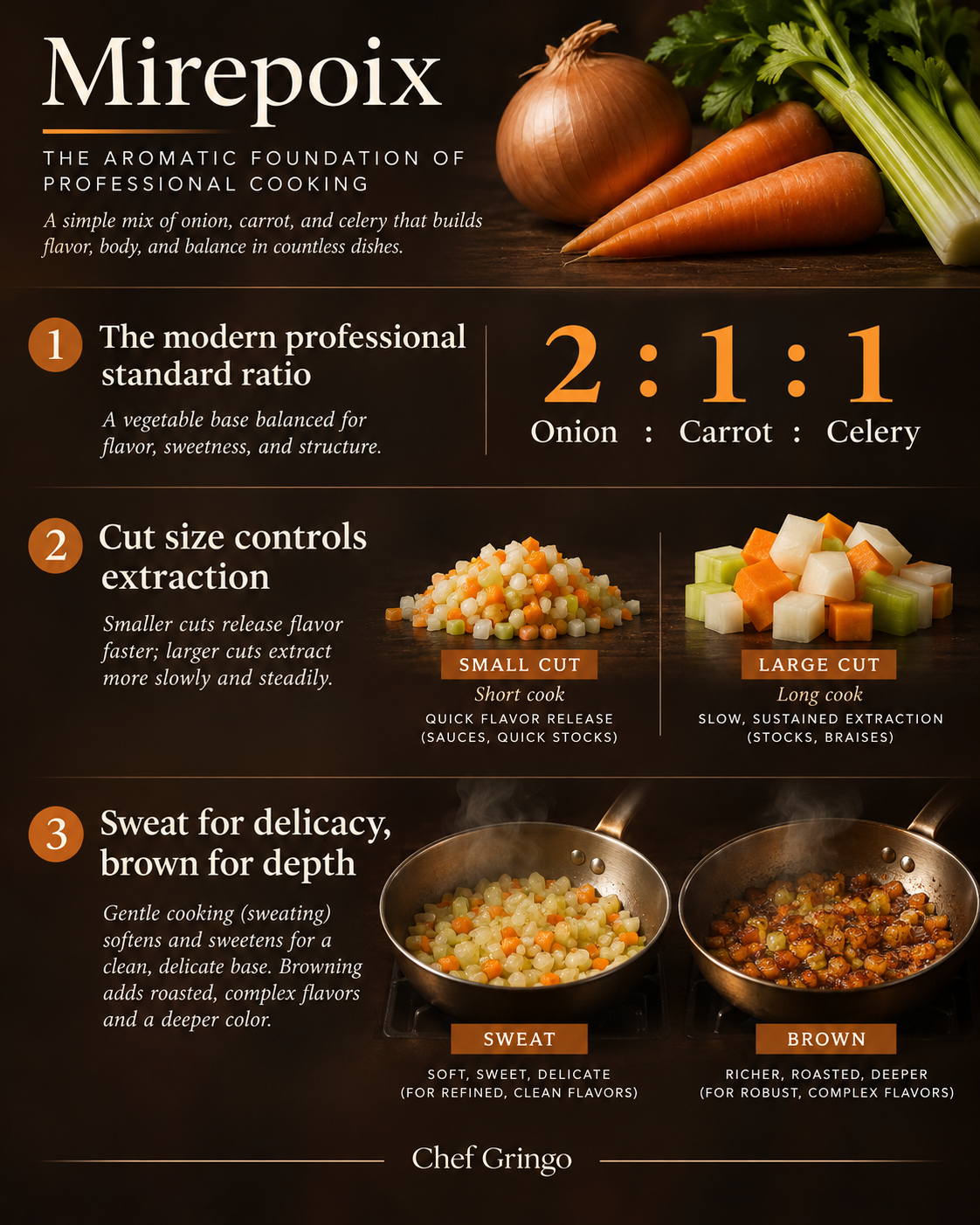
Your knife controls extraction
The size of mirepoix is not decorative. It changes how quickly the vegetables soften, release soluble compounds and interact with the cooking liquid.
Professional culinary instruction generally matches smaller cuts with shorter cooking times and larger cuts with longer cooking times. The goal is useful extraction—not showing off a perfect brunoise that will be strained into the garbage six hours later. Professional Cooking: mirepoix and production technique
Small dice gives the liquid access to more cut surface quickly.
Medium dice balances extraction with structure for soups, braises and stews.
Larger rough cuts are practical for long-simmered stocks and large braises.

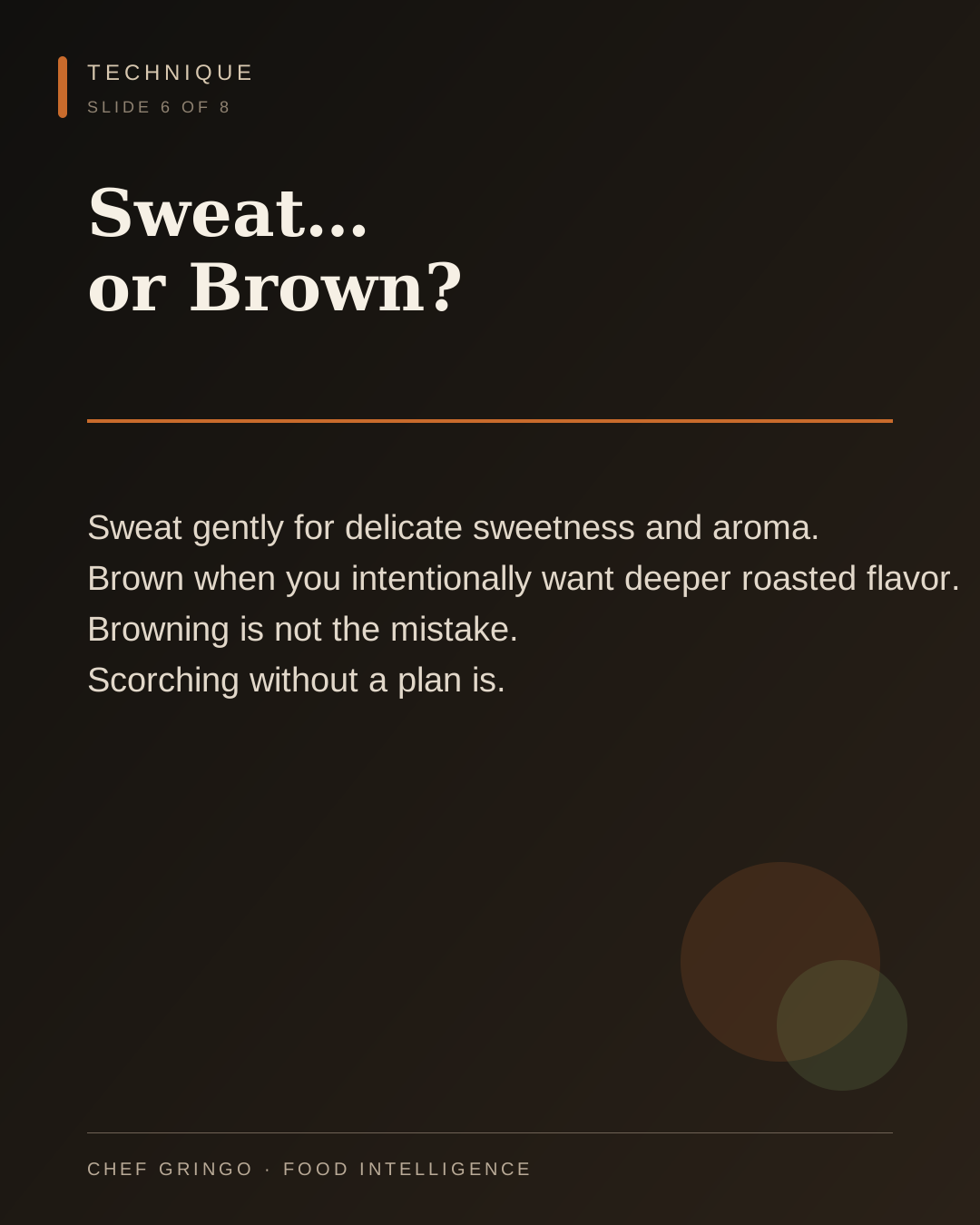
Sweat or brown? Stop treating it like a moral question.
“Sweat, don't brown” is useful advice when the target is a pale, clean, delicate flavor. It is not a universal law.
Sweating mirepoix over controlled heat softens the vegetables and develops sweetness and aroma without introducing much toasted color. That is useful for many soups, white sauces and lighter preparations. In a brown stock, dark braise or robust sauce, intentionally developing more color can be exactly what the dish needs.
The mistake is not browning. The mistake is producing a flavor you did not intend—especially scorched bitterness—because the pan was too hot or the cook stopped paying attention.
The aromatic-base family is bigger than France
Mirepoix is one solution to a nearly universal culinary problem: how do you create a layer of flavor underneath everything else?
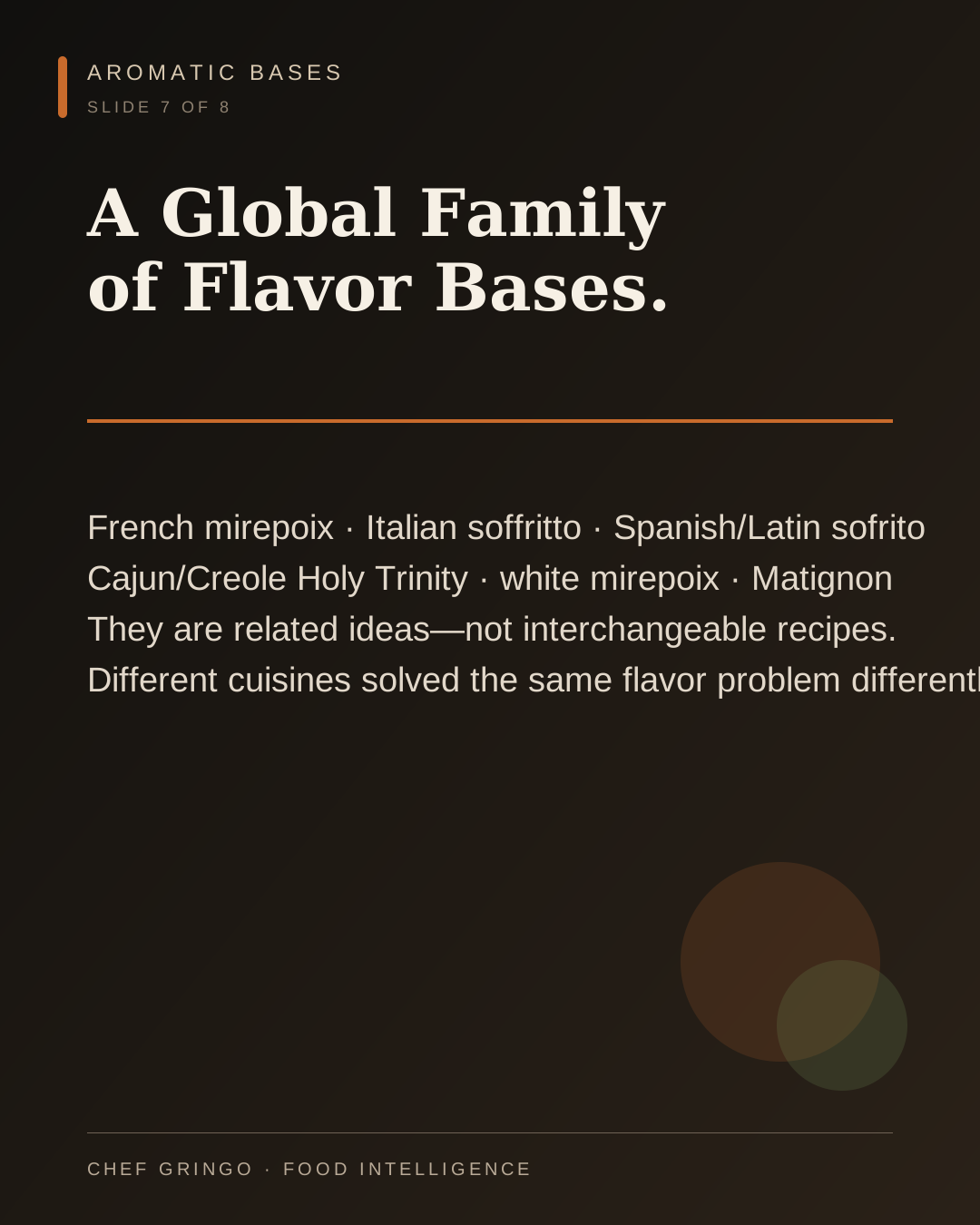
Italian cooking has soffritto. Spanish and many Latin American traditions use forms of sofrito. Cajun and Creole cooking is famous for the “Holy Trinity” of onion, celery and bell pepper. French kitchens also use related preparations such as white mirepoix and Matignon.
These are related principles, not interchangeable recipes. Their ingredients differ by region, agriculture, dish and tradition. The useful connection is conceptual: aromatic ingredients meet fat and controlled heat before the main body of the dish develops.
White mirepoix and Matignon: two useful distinctions
A white mirepoix swaps or reduces ingredients that would add stronger color, often leaning on pale aromatics such as onion, leek, celery or celeriac and parsnip. Its job is familiar: build aromatic depth without turning a pale stock or sauce orange-brown.
Matignon is historically related but should not simply be treated as another spelling of mirepoix. Classical versions may include aromatic vegetables with ham, butter, herbs and wine, and the preparation may be incorporated more directly into the finished dish. The distinction is another reminder that classical culinary vocabulary describes functions and methods—not just ingredient lists.
Five mistakes that flatten a mirepoix
- Using the same cut for every job. A ten-minute sauce and a six-hour stock do not need identical vegetable geometry.
- Turning on the heat before the mise en place is ready. Aromatics punish distraction. Have the cut vegetables, fat, herbs and next step ready before you start.
- Cooking too hot by default. High heat can move a delicate base into browning before the vegetables have softened evenly.
- Confusing “no color” with “no cooking.” Sweating still takes time. The goal is softened, aromatic vegetables—not warm raw dice.
- Treating 2:1:1 as a law. The standard is useful precisely because a cook who understands it can intentionally depart from it.
When the whole kitchen starts smelling like onion, celery, carrot and herbs instead of raw chopped vegetables, you are finally getting somewhere. Good foundational flavor is usually the result of time, patience and enough attention to notice the transition.
The bottom line
Mirepoix became simple because professional kitchens needed a useful shorthand. That is a strength, not a weakness. But shorthand becomes dangerous when cooks stop understanding the idea underneath it.
2:1:1 is a modern professional standard, not culinary scripture. Onion, carrot and celery work because their flavors complement one another. Cut size changes extraction. Heat changes the aromatic result. Historical mirepoix was broader and richer than today's formula. Other cuisines solved the same problem with different ingredients.
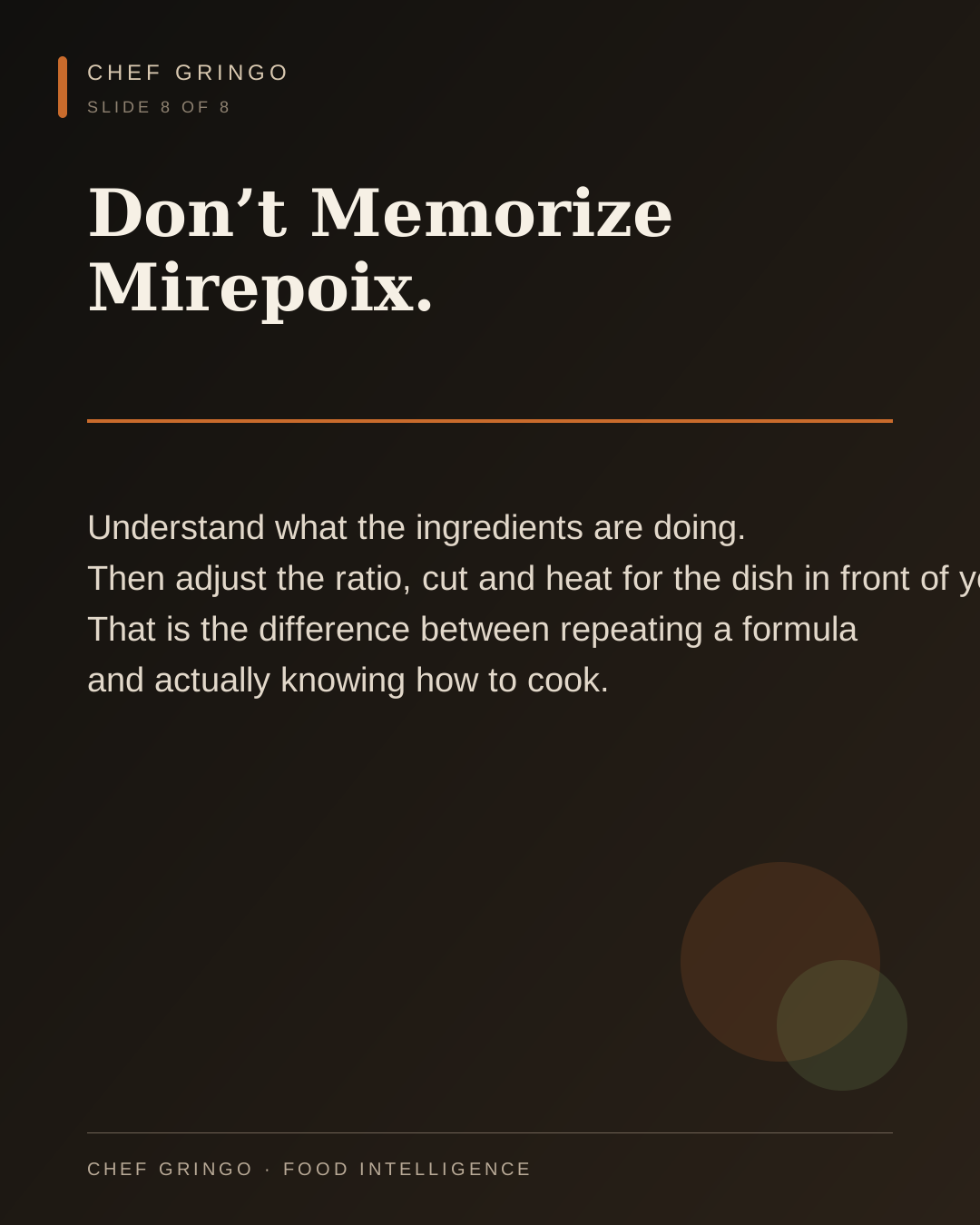
Don't memorize mirepoix. Understand what it is doing. Then you can build flavor even when the recipe is gone.
Sources & further reading
- Online Etymology Dictionary — “mirepoix” — etymology and the traditional Duc de Mirepoix attribution.
- Bibliothèque nationale de France — Les fondamentaux de la gastronomie — historical context for the development of French professional cookery.
- Antoine Beauvilliers, L'Art du Cuisinier (1814) — digitized historical culinary text.
- Auguste Escoffier, Le Guide Culinaire — classical professional reference.
- Culinary Institute of America — Recipes Between the Lines: Mirepoix — modern professional ratio and technique.
- Wayne Gisslen, Professional Cooking — production technique and cut-size guidance.
- American Chemical Society — onion flavor chemistry.
- Open-access review — carrot aroma chemistry.
- Kurobayashi et al. — celery volatiles and chicken broth sensory effects.